My new apartment lies adjacent to an alley.
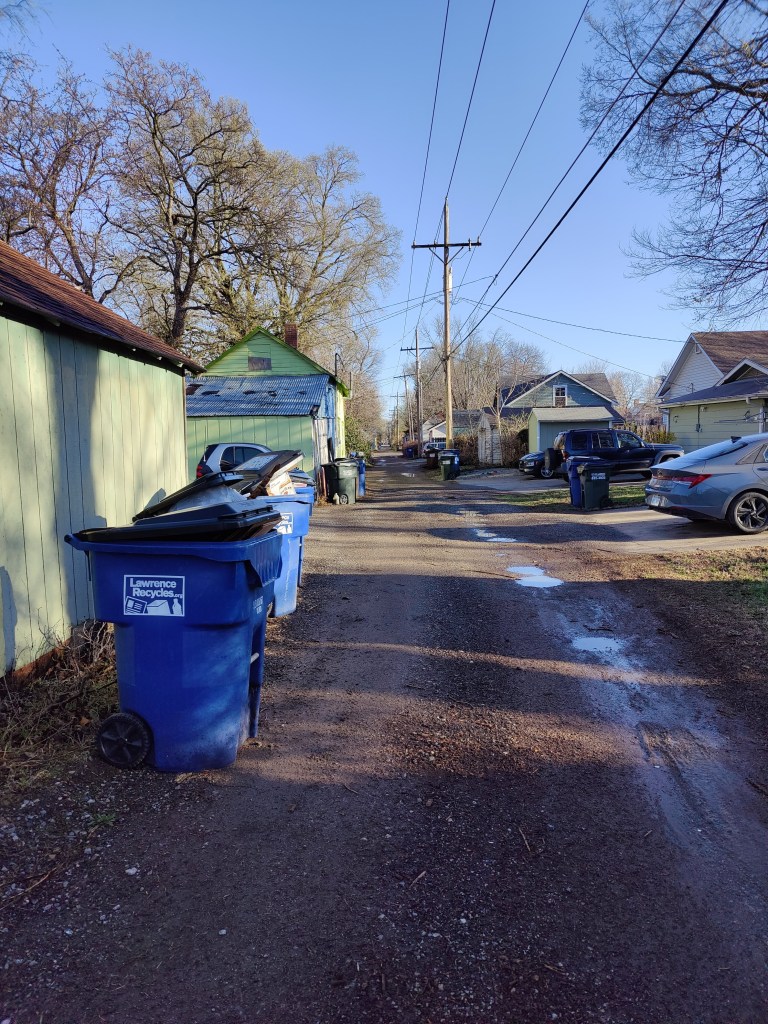
The alleys in East Lawrence run north-to-south, parallel to the streets named after states, and perpendicular to the numbered streets. I live one house down from the pale, yellow, clapboard house at the corner of New York and 10th. The alley behind my apartment connects 10th St. to 11th St., and continues on in both directions for several blocks.
I’ve never before lived in a neighborhood with alleyways, nor even really understood what alleys are, or how they work. To me, a country bumpkin, they’ve always just been settings in films and television shows—venues for feverish chase scenes, usually on foot, inevitably ending at a brick wall or a chain link fence; or a place where the world-weary but broodingly handsome short order cook and the waitress with the sad smile might share a smoke between dumpsters. Alleys were usually in New York City, although I was pretty sure that other big cities had them. Alleys were also places for Bob Seeger to have sex, when he was doing his sexy “Night Moves,” and in this context, they were in the vicinity of trusty woods. So possibly there were small town alleys, as well. I understood that alleys were liminal spaces, neither streets nor sidewalks, where it was always nighttime, and backlit steam was likely to be pouring from a manhole cover on a nearby street. I knew this much. But mostly, alleys were not included on my map of the world.
But now that I’ve had the opportunity to walk up and down the alleys of my neighborhood, I see them in a whole new light—daylight, specifically, as opposed to the chiaroscuro severity of the nocturnal alleys of your average police procedural. And my eyes have been forever opened to the more nuanced nature of alleys. I have become an alleyphile.
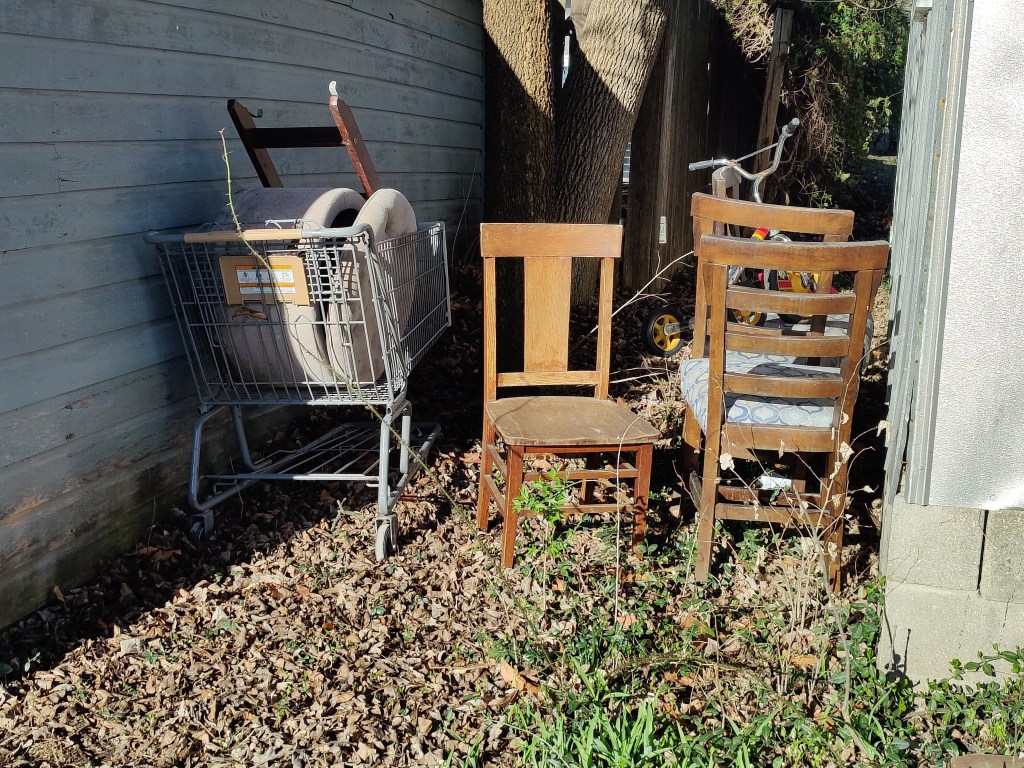
I fell in love with my own alley the first sunny, rain-washed morning I walked it. Like all the alleys in my neighborhood, it is a narrow gravel drive running along the backsides of the houses which line adjacent streets. This is where the garbage cans patiently await their weekly collection. More significantly, it is the province of back yards: weathered sheds and wood piles; collected shopping carts and discarded chairs; basketball hoops and chicken coops.
Walking the alleyways, I quickly came to the realization that these are areas of heightened intimacy with one’s neighbors. Part of what engenders this intimacy is that one’s own guard is lowered. Off the main drag, walking alone and unhurried, unbothered by traffic, untethered from one’s own self-consciousness, the need to don the pedestrian’s mask of non-threatening neutrality—Nothing to see here, folks!—the curious alley walker is free to engage all their senses, to study their surroundings, to meander and dawdle and expand the limits of their viewfinder. Look up at the trees where a sassy cardinal is singing his heart out and a grey squirrel is performing parkour; look down at ground level and there’s a bunny darting across the path and a Snapple cap mutely proclaiming, “The average human dream lasts only 2 to 3 seconds.” Who knew? In short, in the alley, one may find oneself relaxing into a more receptive posture of attention.
The other source of intimacy is, of course, the privileged view of this back yard world. The front of the house is called the facade for a reason: it is the face we show the world. And we are, most of us, careful to show the world only what we want it to see. Back yards are where our unedited selves are on display. If front yards are aspirational, back yards are where we let our hair down. If front yards are advertisements, back yards are confessions. If front yards are head shots, back yards are mug shots.
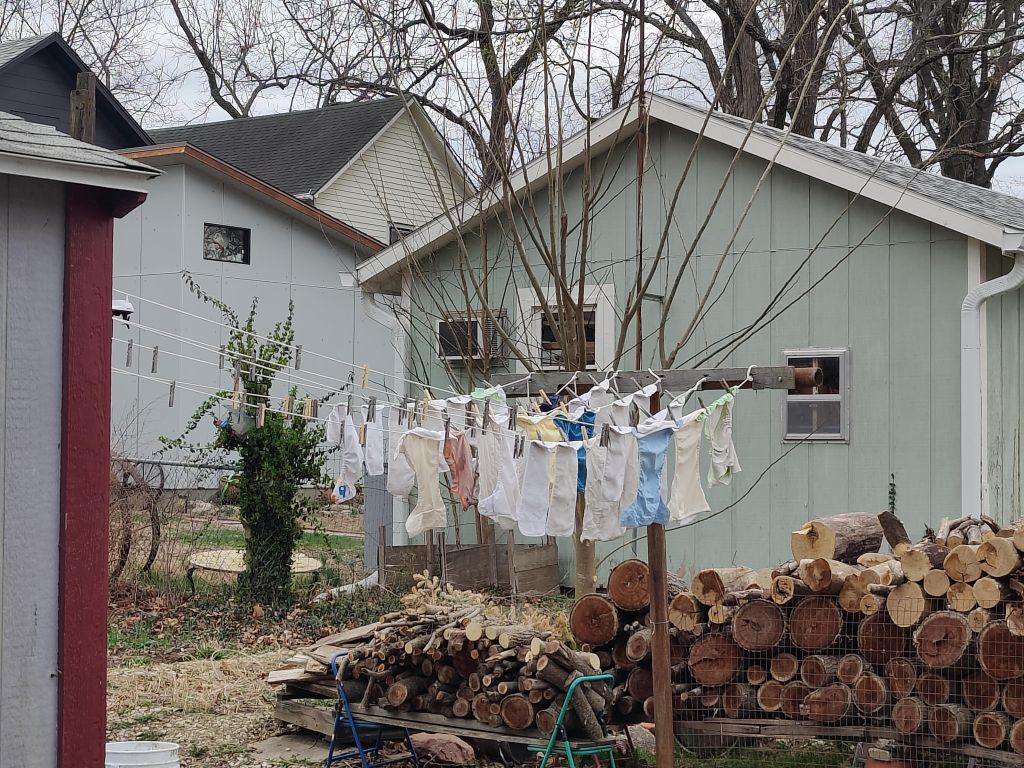
The front yard might, in fact, reveal next to nothing. Perhaps a bunch of crocuses or jonquils are blooming by the porch steps; many of the front yards in this part of town are sporting spring color now. These ubiquitous displays are pretty, and cheerful, but impersonal. The back yards, though—the back yards tell stories. This is where you learn that the teenage boy next door is using an old soccer ball with a split seam to shoot hoops in the tattered net that hangs above a square of trampled dirt. This is where you learn that the family one block to the north has a baby: there are cloth diapers hanging on their clothes line. This is where you learn that your neighbor to the south keeps chickens—just two hens, but they look sleek and plucky as they scratch and peck at the base of a blooming tulip tree. This is where you meet another neighbor as he is taking out his recycling in his pajamas, late on a Sunday morning, and hear the bright cacophony of beer bottles as they tumble into the blue bin. This is where you encounter the heady fragrance of frying bacon that same morning (notably, a kitchen is far more likely to be in the back of the house than the front, which is the domain of living rooms, parlors, foyers). Now you know that your neighbor is not a robot—they eat human breakfast, just like you! And perhaps they are padding about in fuzzy slippers, and walking with a slight limp, owing to a recent hip surgery, and patting their dumb but beloved golden retriever on the head with one hand while they flip bacon with another. This reverie sidles up and softens your heart, unbidden. The alley has allowed your humanity to seek out and brush up against another’s, despite your respective anonymity.
The back yard is where you see the abandoned exercise equipment; the old above-ground pool, now collapsed like a souffle and gathering dead leaves like a raiment of mourning; the swing set with the broken chain; the wheel barrow with a flat tire: all the detritus that is sloughed off by a household as it grows up, grows old, grows bored with or neglectful of old enthusiasms.
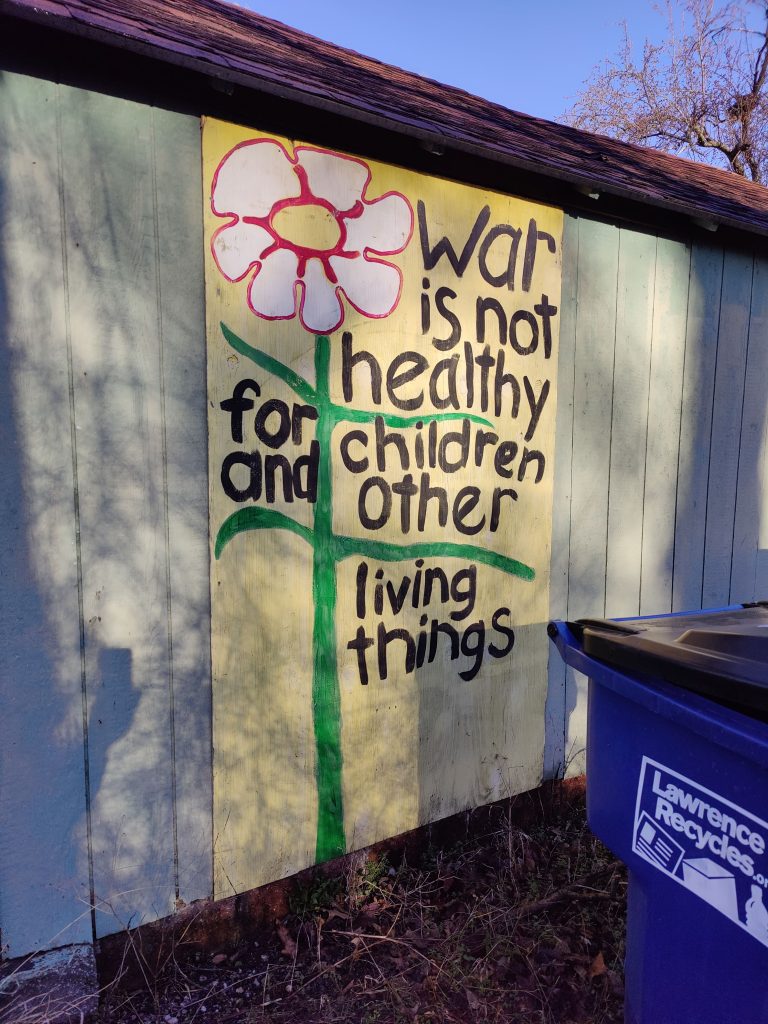
To walk these alleyways is to walk past a series of dioramas in a museum of natural history, in a room dedicated to a college town in the Midwest United States in the spring of 2025: vignettes of human habitation as it unfolds, piebald and piecemeal, with all of its messiness and regrettable choices and weed patches and muddy plastic bags lying next to—not actually in, though they’re so close!—the garbage cans. And here also are the unruly herb gardens and private murals on old sheds and laughter filtering out from behind someone’s screen door, and the smell of the toast that will accompany that bacon and those freshly-laid eggs. You inhale deeply before walking home.
 Howdy, pilgrim
Leave a comment